Bionid Briefing 2600CE
Bionid Hivemind Entity (BHE). Prepared for the Anti-Bionid Federation Council.
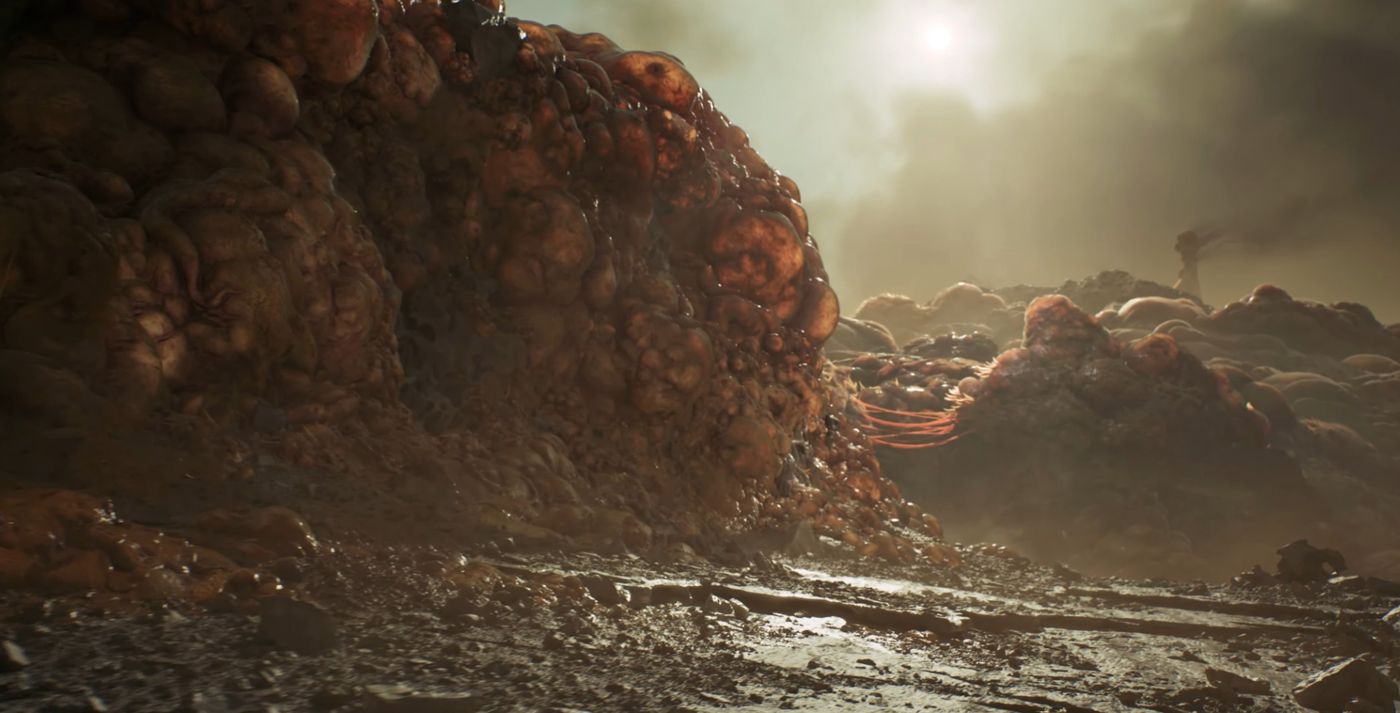
BIONID HIVEMIND ENTITY (BHE)
Classification: MAXIMUM THREAT PRIORITY – EXISTENTIAL BIOLOGICAL THREAT
Prepared for: Anti-Bionid Federation Council
Executive Summary
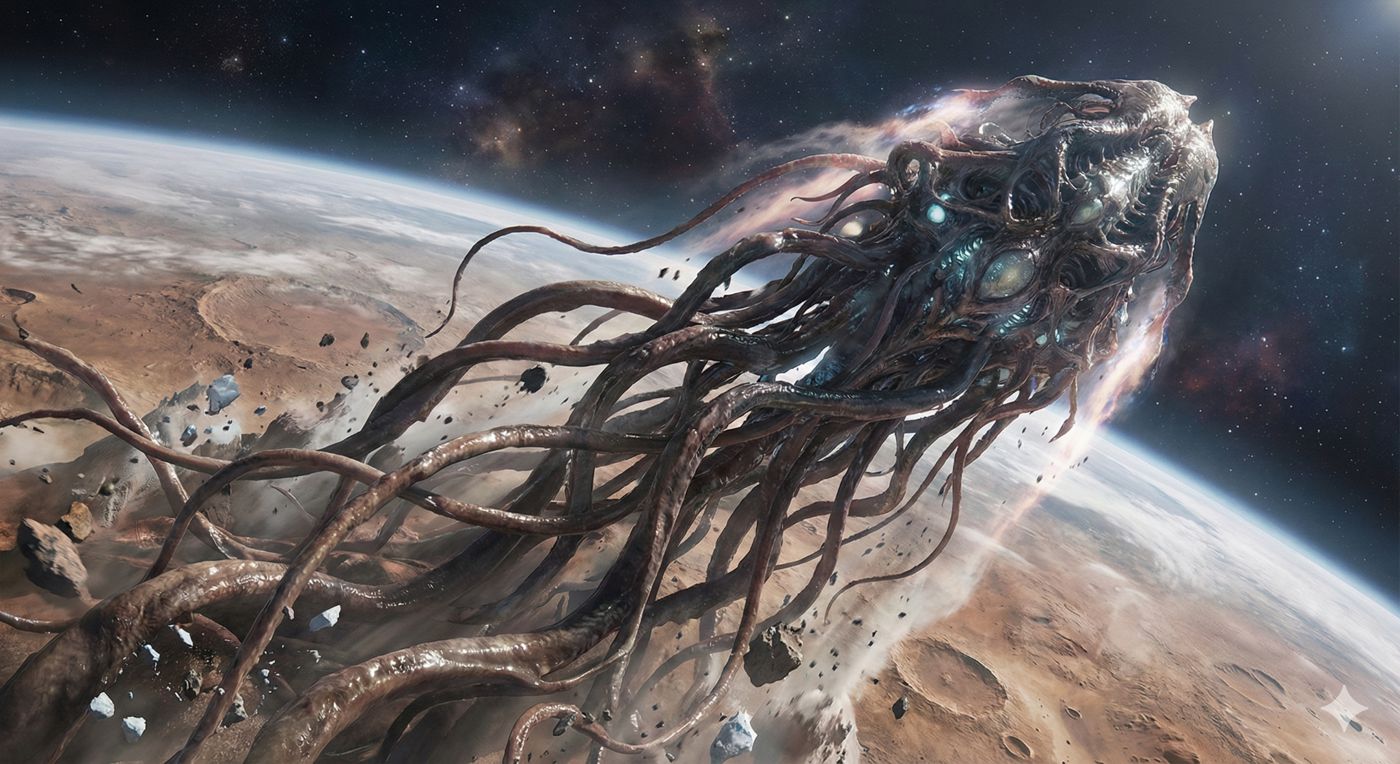
The Bionid Hivemind Entity (BHE) represents the most severe non-state existential threat yet encountered by human civilisation. The Bionids are not a conventional species, polity, or civilisation, but a distributed, adaptive, predatory biosystem operating under a unified hive intelligence. Their method of expansion involves planetary-scale biological consumption, conversion of all organic matter into weaponised biomass, and subsequent projection of that biomass into interstellar space as mobile Hivefleets.
Once a planet is fully compromised, total biospheric loss follows. No confirmed cases exist of successful long-term reclamation of a fully consumed world. During the Bionid War, Sector 5 experienced catastrophic losses, with multiple border systems rendered permanently sterile.
The BHE is assessed as non-negotiable, non-deterrable, and incapable of coexistence with human or other sentient life.
The Bionid threat is an existential, extinction level threat.
Origin and First Contact
The Bionids were first identified by the Zeyland-Butani Corporation during deep-range exploratory and extractive operations in 2575. Initial contact was misidentified as an anomalous biosphere collapse event. Within standard months, multiple adjacent systems exhibited identical signatures.
The rapid cascade of infestations led to the formation of the Supreme Allied Fleet in 2578, an ad hoc but unprecedented agglomeration of military assets drawn from multiple sectors and sovereign polities. Despite this response, containment failed in several theatres, particularly along the Sector 5 and Sector 6 frontier. Active combat operations of the Bionid War continued until 2588.
Core Biological and Strategic Characteristics
Hive Intelligence
The Bionids function as a singular distributed intelligence. Individual organisms have no observable autonomy; all actions appear coordinated toward the expansion, defence, and optimisation of the total biomass.
Communication mechanisms remain unconfirmed. Prevailing hypotheses include:
- Neural-telepathic hive linkage, potentially exploiting exotic physics
- A hybrid system, allowing redundancy and resilience under attack
Post-war studies have shown BHE has exhibits vast morphological differentiation, with genetic memory ability. Connected genetic dynasties of BHE swarms are capable of learning and utilising past strategies and morphological forms. As a result, BHE infection and planetary consumption cycles have accelerated and their morphological varieties have narrowed over the observed period.
BHE intelligence capabilities are unknown, though highly advanced. Experts have suggested a central caste of ‘mind forms’ may exist, or a more distributed nodal form of intelligence.
Infection and Planetary Consumption Cycle
Phase A - Spore Seeding (0 - 150 Days - observed range)
Infection begins with microscopic or aerosolised spores introduced via meteoric debris, contaminated vessels, or deliberate biopod deployment.
Phase B - Biospheric Subversion (150 - 450 Days)
Native flora and fauna are rapidly assimilated. Higher organisms are reconstituted into functional biomass, stripped of identity but repurposed as drones or processing mass.
Phase C - Morphological Differentiation (300 - 600 Days)
The hive extrudes specialised forms optimised for:
- Combat
- Resource processing
- Atmospheric and orbital denial
- Hivefleet construction/agglomeration
Phase D - Planetary Exhaustion (400 - 1000 Days)
Once all biologically useful matter is consumed, remaining inorganic mass is left inert. The planet is effectively dead. BHE has been observed both leaving planets prior to Planetary Exhaustion stages or failing to achieve requisite biomass or materials to achieve required morphological differentiation into Hivefleet/spaceborne forms.
Phase E - Hivefleet Formation (500 - 1000 Days)
The BHE has successfully launched into deep space as a spaceborne entity.
Known Bionid Forms
Plasnids (Surface-to-Space / Artillery)
Plasnids are fixed or semi-mobile planetary organisms functioning as biological mass-energy weapons. They catalyse internal bio-fusion or plasma-like energetic reactions, excreting concentrated energy discharges capable of:
- Engaging orbital vessels
- Denying low-orbit insertion
- Inflicting catastrophic damage on capital ships
These systems appear instinctively prioritised against high-threat targets, possibly ‘guided’ by Biopods.
Hivefleets
Hivefleets are entire planetary biomasses launched into space, forming vast organic armadas. Characteristics include:
- Extreme redundancy and self-repair
- Organic armour resistant to kinetic and energy weapons
- Ability to sustain damage while continuing offensive operations
Hivefleets typically operate at a similar combat effectiveness as a standard Battlefleet. Hivefleets and their drone entities appear to be susceptible, or have limited defences against nuclear weaponry. During the Bionid War, capital ships carried twice the usual complement of 6 nuclear warheads per capital ship. Following the Bionid War, most polities increased their stockpiles of thermonuclear weapons for the express purpose of deployment against the Bionid threat.
FTL Capability: Hivefleets demonstrate slow but consistent FTL movement, averaging 1 hex per 100 days (1 turn). The mechanism is unknown. Leading theories include:
- Integration and enslavement of captured FTL-capable vessels
- Neurological domination of sentient crews to operate ship systems
- Indigenous exotic bio-energetic propulsion beyond current science
No theory fully accounts for observed performance.
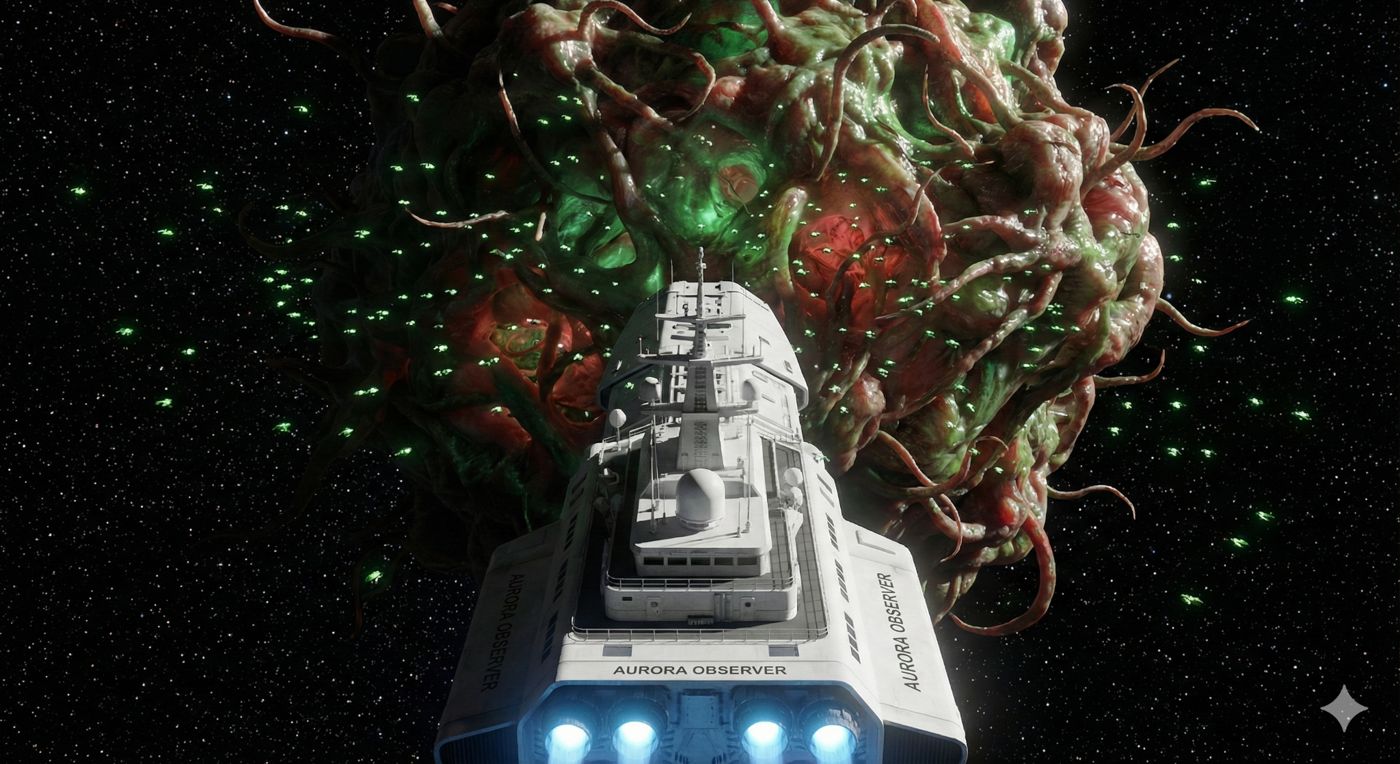
Biopods (Suicide Fighter / Boarding Organisms)
Smaller, fast-moving organisms deployed in swarms. Primary roles:
- High-speed ramming attacks to inflict damage
- Hull penetration and internal infestation
- Boarding actions resulting in rapid crew assimilation
Once aboard, infection times can be measured in minutes, not hours. Primary methods of defence include close fighter escort, carrier formations, point defence and - for combat ships in the Area of Operations (AO), venting atmosphere prior to engagement to prevent quick airborne contamination.
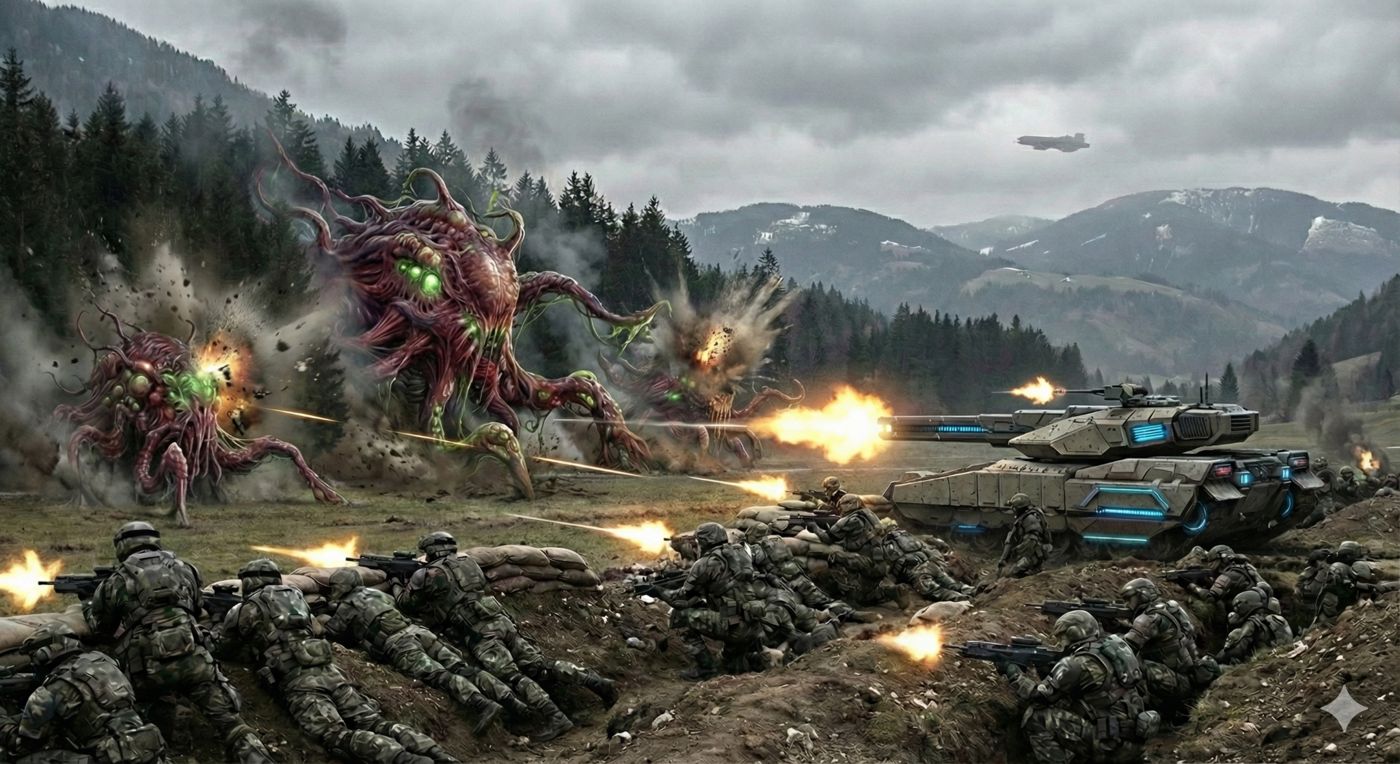
Atmospheric and Ground Forms
A wide variety of lesser forms exist, many poorly catalogued due to high mortality among observers. Common traits include:
- Extreme morphological plasticity
- Rapid task-specific adaptation
- Willingness to self-sacrifice for hive objectives
Lurkers
Towards the end of the Bionid War a horrifying new form was encountered on the remote outpost world of Delta Green 49 in 2587, termed the Lurker or Zombinid. Lurkers infiltrate the human body through various cavities and orifices, such as the mouth, before burrowing directly into the brain to exert control over the host’s mind. Initially, victims may exhibit no outward signs of infestation; however, their health gradually deteriorates as the BHE consumes them for sustenance. Once the Lurker forms have depleted their host to the brink of death, they either self-remove or are extracted, allowing them to propagate and initiate a new cycle of infection. Whilst under the control of a Lurker form, the human host is under the direct control of the BHE.
The sole documented incident involving these Bionid forms occurred at Delta Green 49, where their objective appeared to be to infiltrate the Supreme Allied Fleet command by infecting General Zheng Morgan. Due to the extreme danger of this new form of BHE, genetic samples were taken from the victims before the planet was glassed by nuclear weaponry from orbit.
Strategic Behaviour and Doctrine
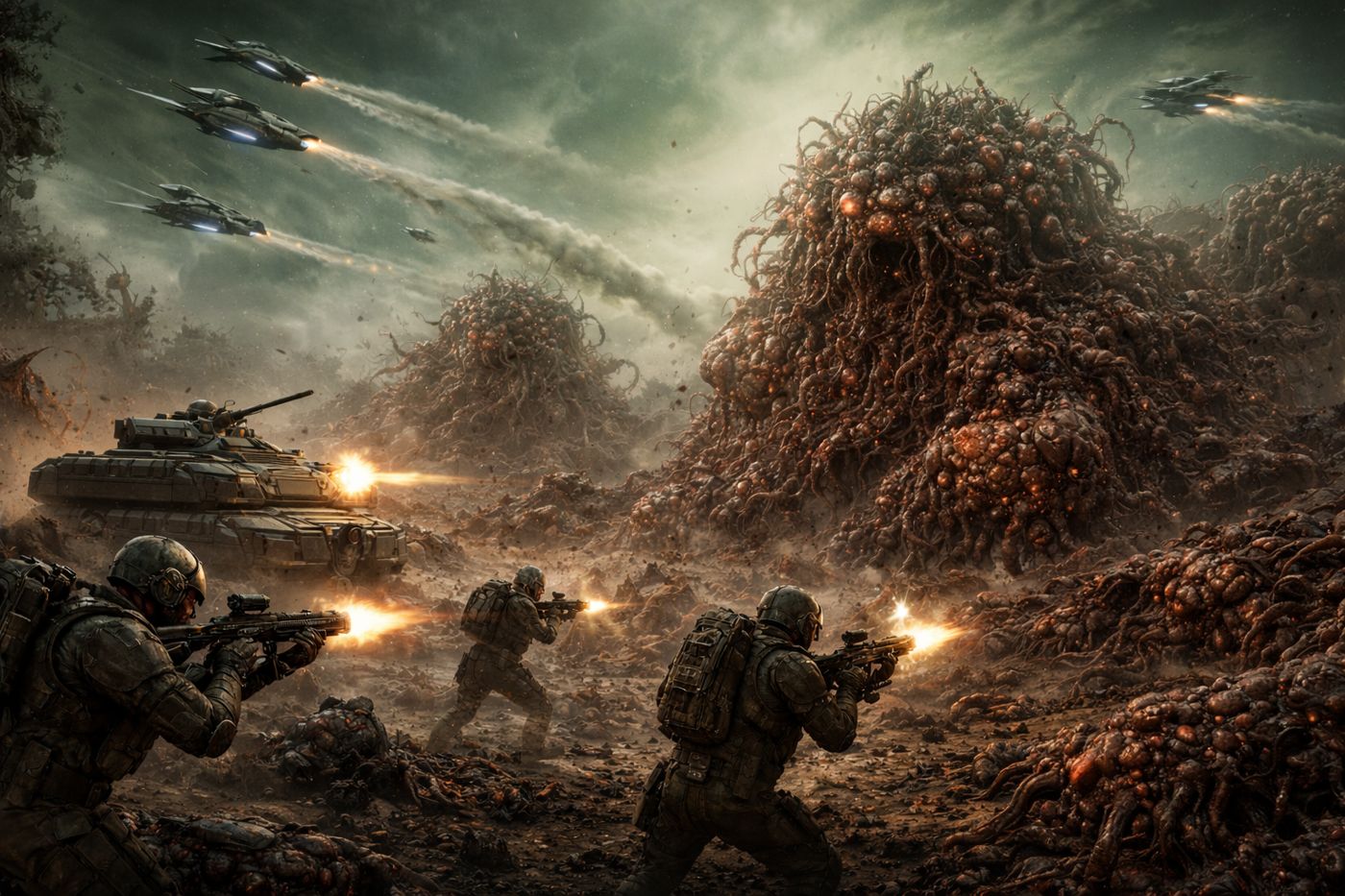
The BHE does not display concepts analogous to fear, retreat, or preservation of individual units. Instead, it exhibits:
- Overwhelming force concentration at decisive points
- Attritional indifference to losses
- Adaptive counter-evolution in response to repeated tactics
Campaign analysis suggests the hive actively learns at the theatre level, altering future engagements based on prior encounters.
Psychological and Information Warfare Impact
Bionid encounters produce severe psychological effects on personnel, including:
- Acute existential panic
- Breakdown of unit cohesion
- High rates of post-engagement trauma
The visual and tactical characteristics of the BHE, roiling flesh, assimilation of former comrades, and relentless advance, contribute to disproportionate morale collapse if not tightly managed.
Threat Assessment
- Intent: Total consumption of biological matter
- Negotiability: None observed or theorised
- Containment Feasibility: Limited, resource-intensive
- Extinction Risk: High if unchecked
The Bionids are classified as a Maximum Priority Risk to Human Life. Any compromise, delay, or under-commitment materially increases the probability of irreversible losses.
Preliminary Strategic Recommendations
- Immediate destruction of infected worlds once loss thresholds are crossed
- Strict quarantine and inspection of all recovered vessels
- Prohibition on boarding Hivefleet biomass under any circumstances
- Continued research into counter-adaptive weapons and sterilisation technologies
Concluding Assessment
The Bionid Hivemind Entity should be understood not as an enemy civilisation, but as a cosmic predatory process. It does not conquer. It consumes.
Failure to treat the BHE as an existential system-level threat, rather than a military opponent, will result in cascading losses across sectors.
Appendices - Photographic Records