McDoolism
A Theoretical Overview & Historical Record of McDoolism.
McDoolism is a heterodox socialist tendency originating in the late 24th century, synthesising Posadism, Maoism, the Association of Autonomous Astronauts, Cosmic Communism, Russian Cosmism, Left Accelerationism, and elements of Pentev Thought. It takes its name from Harley McDool (2318–2367 CE), philosopher, agitator, and leader of the ill-fated 2362 McDoolist Uprising on the distant colony world of Ghrian Dhearg - a rebellion that lasted eight years before its violent suppression by United Earth forces in 2368.

Harley McDool
Harley McDool was born in 2318 in a mining settlement on the outer moon of Arcturas. The child of indentured Cerean mineral workers, she received a scattered education via salvaged data-cores and black-market theory archives. By age nineteen, she had digested the complete works of the Posadist tendency, early Maoist texts, and the recovered anarcho-cosmonautic pamphlets of the old Association of Autonomous Astronauts - a late 20th century Earth collective that had envisioned a community-controlled, decentralised space programme as an act of working-class liberation.
McDool’s great theoretical achievement was to recognise that these currents - separated by centuries and light-years - were secretly continuous: different expressions of a single suppressed tradition that understood space not as a frontier for capital, but as a commons for species-liberation. She synthesised them into what she called, with characteristic bluntness, “the tendency” - though her followers retroactively named it McDoolism after her death.
She was by all surviving accounts a charismatic and difficult figure: brilliant, volcanic, given to long theoretical monologues and sudden practical bursts of organising energy. Her Collected Broadcasts, transmitted on pirated frequencies across the human settled space between 2355 and 2365, remain the primary textual source for McDoolist thought.
“The stars are not the prize of capital. They are the inheritance of every mind that ever looked up and refused to be owned.” - Harley McDool, Broadcast 1107: “On the Cosmic Commons,” 2358
Core Tenets of McDoolism
The Cosmic Mass Line. McDool fused Mao’s Mass Line - the idea that correct socialist consciousness must emerge from the lived experience of the masses, not be imposed from above - with the cosmist conviction that humanity’s destiny is cosmic in scale. The revolutionary party’s role is not to lead the people toward the stars, but to learn from the people already living among them: the miners, cargo pilots, station workers, and outer-system labourers whose daily existence is already interstellar. Theory must be drawn from their conditions, refined, and returned as praxis. This is the Cosmic Mass Line.
Posadist Alien Solidarity & Multi-Species Communism. McDoolism inherited and radicalised Posadism’s conviction that extraterrestrial civilisations, by virtue of having survived long enough to develop interstellar travel, must have transcended capitalism. McDool extended this: contact with alien life is not merely probable but politically obligatory. She generalised Posadas’ writings on cetacean solidarity into a broader multi-species solidarity - any being exhibiting collective intelligence is a potential comrade. McDoolism decries the theory of the cosmic Dark Forest as an attempt to prohibit cosmic solidarity. The Ghrian Dhearg Commune maintained an official policy of attempting radio contact with non-human intelligences throughout its existence and believed the major powers were hiding alien contact from the public.
Autonomous Astronautics. From the Association of Autonomous Astronauts, McDoolism drew its most practically organisational tenet: space travel must be decentralised, community-controlled, and liberated from state and corporate monopoly. United Earth’s stranglehold on faster-than-light transit was, for McDool, the defining feature of 24th-century imperial capitalism - the enclosure of the cosmos itself. McDoolist cells were expected to develop independent transit capacity: salvaged vessels, cooperative fuel networks, pirated navigation data. The Commune maintained two ships, the Sovetsky Kosmos and the An Rionnag Dhearg, crewed on cooperative socialist principles.
Russian Cosmism & the Resurrection Project. McDool was deeply shaped by Fyodorov’s Cosmist vision: that the ultimate task of humanity is the literal, physical resurrection of all who have ever died, the conquest of death, and the colonisation of the cosmos as the material basis for universal liberation. McDool reframed this politically: every person who died under capitalism - of poverty, overwork, colonial violence - is a casualty whose death demands a reparative cosmic future. The McDoolist project is therefore not merely for the living but for the active remembrance of cosmic capitalism’s past victims. This gave McDoolism an eschatological grandeur that critics noted functioned very much like a secular religion.
Left Accelerationism. Where many socialist tendencies of the time were suspicious of United Earth’s vast technological apparatus, McDoolism took an accelerationist position: the technologies of colonial extraction - the mining drones, the orbital platforms, the atmospheric processors - are not inherently capitalist. They are forces of production held hostage. The revolutionary task is not to smash the machine but to seize it and redirect it. McDool argued that full development of the productive forces, pushed beyond the limits capitalism can manage, creates material conditions that capital structurally cannot survive. The commune should not retreat into primitivism but accelerate into a technological communism that capitalism cannot contain.
Permanent Cosmic Revolution. Synthesising Trotsky’s Permanent Revolution with cosmist expansion, McDool argued that no single-planet socialism is stable. Capital is interplanetary; revolution must be equally so. A liberated world that does not immediately propagate revolution across star systems will be isolated and crushed - exactly as Ghrian Dhearg was crushed. The Commune was understood by McDool not as failure but as a first pulse of revolution among the stars.
The General Will. From late 23rd-century Synthetist socialist thought - particularly the Bogdanovist-derived “Noosphere Commune” theorists - McDool drew the concept of a future collective consciousness: the Noospheric General Will. As communication technologies and cognitive augmentation advance, the distinction between individual and collective dissolves. McDoolism holds that the ultimate political form is neither party, nor council, nor federation, but a freely associating cosmic mind - diverse, non-hierarchical, spanning worlds - capable of arriving at revolutionary consensus without coercion. The commune is, in this view, a prototype noosphere.
The Horizontal Cadre. Despite her own considerable personal authority, McDool was theoretically anti-vanguardist. Her preferred organisational form was the horizontal cadre: small, autonomous, locally rooted cells, linked by shared theory and communication protocols rather than command structures. The tension between McDool’s charismatic centrality and his anti-hierarchical theory was a live contradiction within the Commune, much debated by later McDoolist scholars and activists, who later favoured a more structured approach.
III. The Ghrian Dhearg Uprising
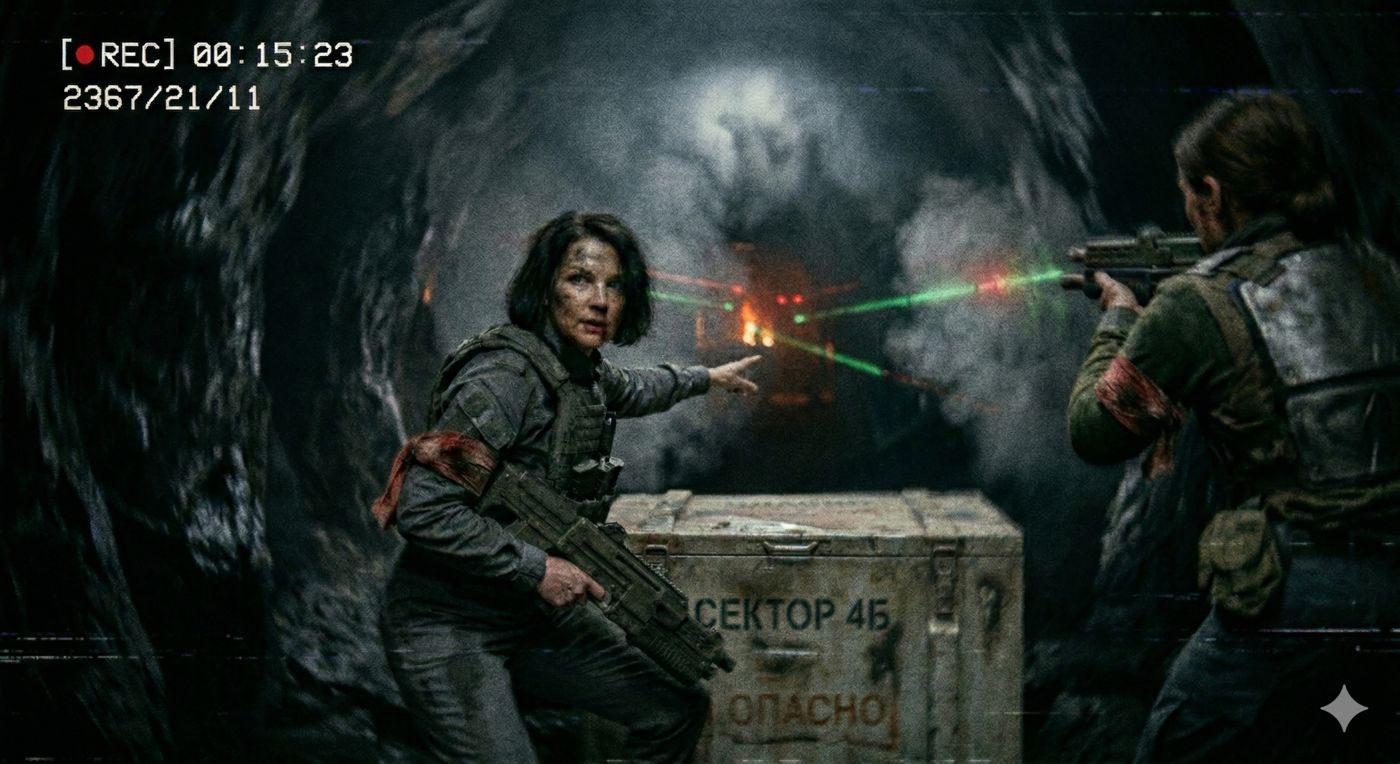
Ghrian Dhearg was a colony world of approximately 50,000 inhabitants. Its economy was dominated by plasma-mineral extraction for the United Earth military-industrial supply chains under conditions of brutal indentured labour, corporate policing, and systematic suppression of organising.
March 2362. Workers at the Vance 106 extraction complex seize the facility and broadcast McDool’s Ghrian Dhearg Proclamation: declaring the planet a free commune, asserting collective ownership of all extraction infrastructure, announcing open diplomatic contact with any non-human intelligences receiving the signal, and inviting all oppressed peoples of the UER to join a permanent interplanetary revolution. Peak Commune membership reaches approximately 21,000.
2363-2364 - The Free Years. The Commune establishes collective governance through rotating councils. Production is reorganised for communal need. The two commune ships begin autonomous transit operations. McDool oversees an experiment in horizontal organisation later documented in the smuggled memoir Red Sun Rising by survivor-historian Mòrag Caimbeul.
August 2365 - Blockade. United Earth military forces announce a full transit blockade of the system. Supply shortages begin. Internal tensions emerge between the accelerationist faction and the autonomist faction.
November 2366 - The Sovetsky Kosmos Incident. The commune ship attempts to break the blockade. It is intercepted and destroyed by Earth enforcement vessels. 23 crew are killed. McDool’s broadcasts from this period are among her most anguished and theoretically dense.
November 2367 - The Final Siege. Earth ground forces land in the northern settlements. The Commune contracts to the Teine Mhòr complex. Harley McDool is severely injured on 3rd December 2367 during the initial stages of the final assault on Teine Mhòr. Surviving Commune members are arrested; most receive indentured labour sentences. A small number escape on the An Rionnag Dhearg and other freighters, carrying McDoolist ideas across the outer systems of the Earth Republic and beyond.
Post-2368 - Martyrdom & Diaspora. The escaped cadre known as the Red Stars carry the tendency’s archives and continue agitation across human settled space. McDool is succumbs to her injuries in 2368 and becomes one of the most powerful martyred figures in subsequent interplanetary socialist movements.
“We did not fail. We did what was required of us. The signal is still travelling.” - Mòrag Caimbeul, Red Sun Rising: Memoirs of the Ghrian Dhearg Commune, 2381
IV. Legacy & Later McDoolist Thought
After the suppression, McDoolism fractured into several tendencies. Orthodox McDoolists maintained strict fidelity to McDool’s Broadcasts, emphasising the cosmist-resurrectionist elements. Accelerationist Harleyites dropped the alien-contact and resurrection elements, focusing on the technological seizure programme. The Noospheric Faction developed the collective consciousness elements into a full political programme, eventually merging with the Pan-Systems Commune movement in the 2390s.
All retained McDool’s central insistence: that the liberation of labour and the liberation of the cosmos are the same project.
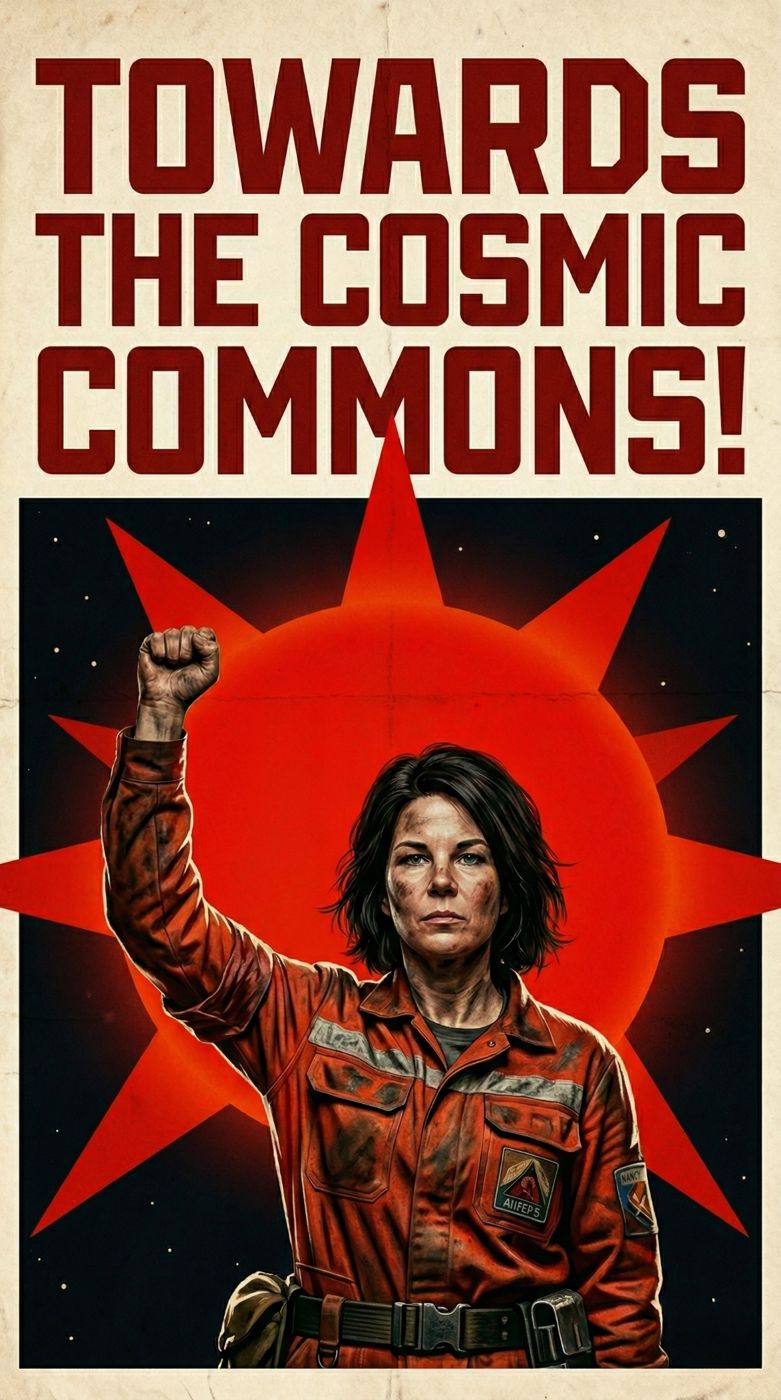
Her image in a miner’s suit against a red sun, fist raised - became one of the most reproduced political symbols of the late 24th century, appearing on commune walls from the inner asteroid belts to the furthest gas-giant stations. The United Earth Republic formally classified McDoolism as a seditious tendency in 2370, an act which, predictably, did more for its spread than any broadcast McDool herself had ever made.
IV. New Star Socialist Federation
With the 2600 Hyperweave Nexus Incident causing a collapse in the cybernetic networks that supported the CASI structure, as Le Grande Republique arose from the disaster, so too did the New Star Socialist Federation, though it was a more tortuous societal birth than the LGR.
As the now-LGR citizens one day experienced a searing headache, falling collectively unconscious, as the signals and communications spread across CASI space and awoke as citizens of a renewed French First Republic, so too did the citizens of the NSSF.
Across Sectors 1 & 7, millions experienced the sudden change in personality. To be continued…